
No-shows cost UK service businesses real money. A single missed appointment in a salon can wipe out £60 to £120 of revenue in one afternoon. Across a week, that adds up fast. The most reliable fix is simple: collect a deposit at the point of booking. This guide walks you through how to ask for one, how to structure a fair policy, and how to make the whole process automatic so you never have to have an awkward conversation about it.
Why Service Businesses Charge Deposits (and Why Customers Accept Them)
The most common question from new clients is: 'Why does your salon charge a deposit?' The honest answer is time. Unlike a product sitting on a shelf, your time cannot be restocked. If a customer books a 90-minute colour appointment and does not show up, you cannot sell that slot back. The deposit compensates you for holding it.
Deposits also change customer behaviour. Research from booking platforms consistently shows that clients who pay something upfront are significantly less likely to cancel last-minute or ghost entirely. Even a £20 deposit on a £100 appointment cuts no-show rates dramatically. The financial commitment creates a psychological one.
For trades and home-service businesses, deposits also cover material costs. A kitchen fitter buying worktops to order, or a painter mixing bespoke paint, needs some security before spending money on a job. Customers who understand this almost always accept a deposit request without pushback.
Your time is the product. An empty slot is lost revenue, not a saved cost.
Deposits reduce no-shows and late cancellations, often by 50% or more.
For trades, deposits protect you from out-of-pocket material costs.
Clients who pay a deposit are more committed and tend to be better customers overall.
Is a Booking Fee the Same as a Deposit?
This comes up a lot, especially in salons and clinics. The short answer: they work the same way in practice, but the word 'fee' signals something slightly different to customers.
A deposit is a partial payment held against the total. If the customer shows up, it is deducted from their final bill. If they cancel inside your cancellation window, you keep it. A booking fee is often a smaller, fixed amount charged purely to secure the slot. Some businesses keep a booking fee regardless of whether the customer shows up, treating it as a non-refundable reservation charge rather than a credit toward the service.
Either model is legitimate. The key is being clear in your terms before the customer books. If your £25 booking fee is non-refundable no matter what, say that plainly. If your 25% deposit is refundable up to 48 hours before the appointment, say that too. Clarity upfront prevents disputes later.
How to Ask for a Deposit Without It Feeling Awkward
Many business owners dread this conversation. They worry it sounds like they do not trust the customer. The trick is to stop treating it as a personal request and make it a standard part of your booking process.
When the policy is built into your online booking flow, you never have to ask. The customer sees the deposit amount, enters their card details, and pays before the booking is confirmed. No phone call, no negotiation. It is just how bookings work with you, the same way a hotel takes a card at check-in.
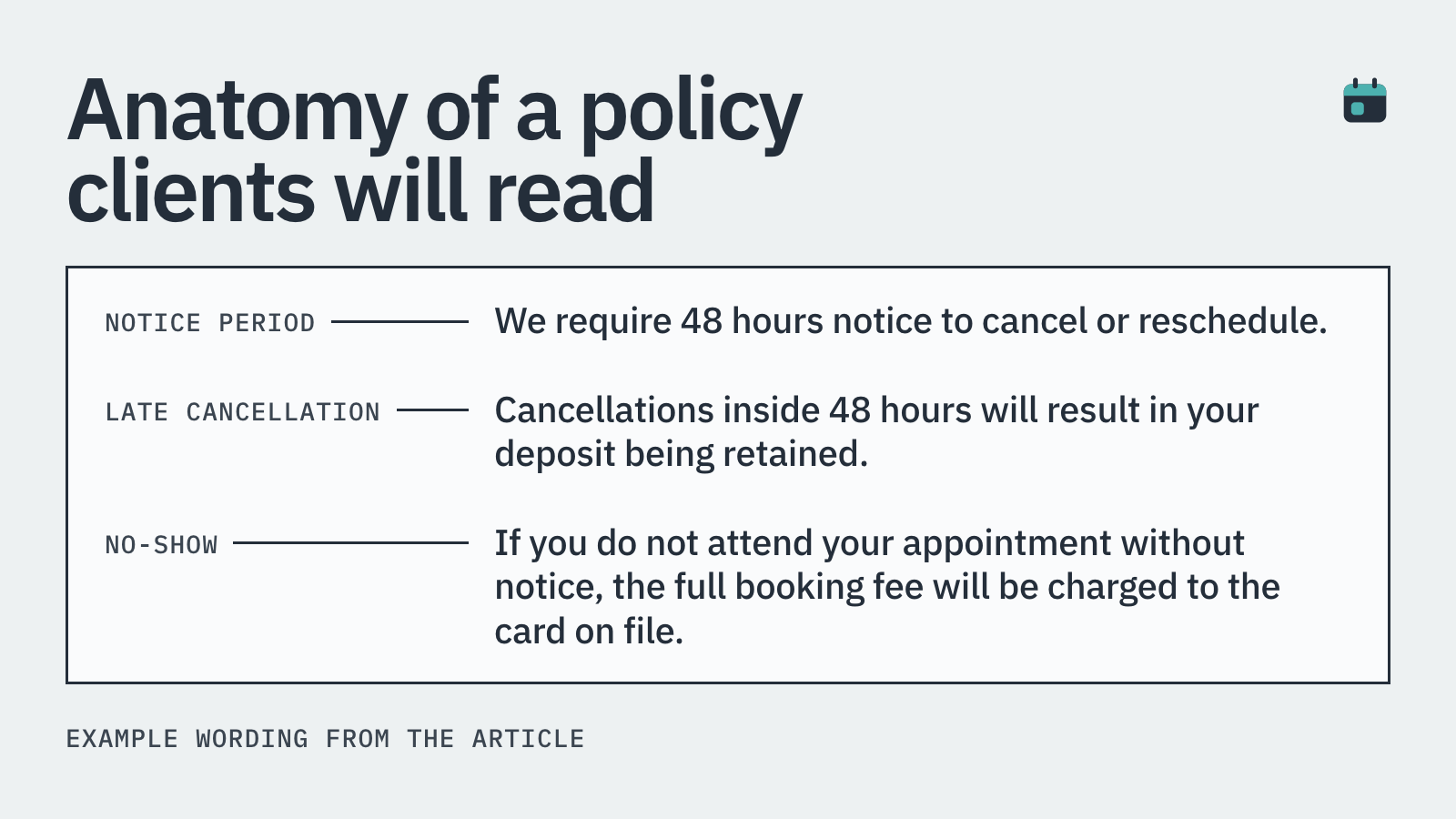
If you do need to communicate it verbally or in writing, keep it matter-of-fact. Something like: 'We ask for a £30 deposit to secure your appointment. This comes off your total on the day. If you need to cancel, we just ask for 48 hours notice.' That is it. No apology, no over-explanation. Most customers will not blink.
Build deposits into your online booking flow so the ask is automatic, not personal.
State the amount, what it covers, and your cancellation window in plain language.
Avoid apologetic framing. Confidence in your policy signals professionalism.
Put the policy in your booking confirmation email so there are no surprises.
How to Design a Deposit Policy That Is Fair and Enforceable
A good deposit policy answers four questions: how much, when it is taken, when it is refundable, and what happens if the customer cancels or does not show.
On amount: a common approach is 20% to 50% of the service value, or a flat fee for lower-cost services. Salons often charge £20 to £50 for colour bookings. Trades typically ask for 25% to 30% of the job value upfront. Freelancers and consultants often take 50% before starting work. Pick a number that covers your time and materials if the job falls through.
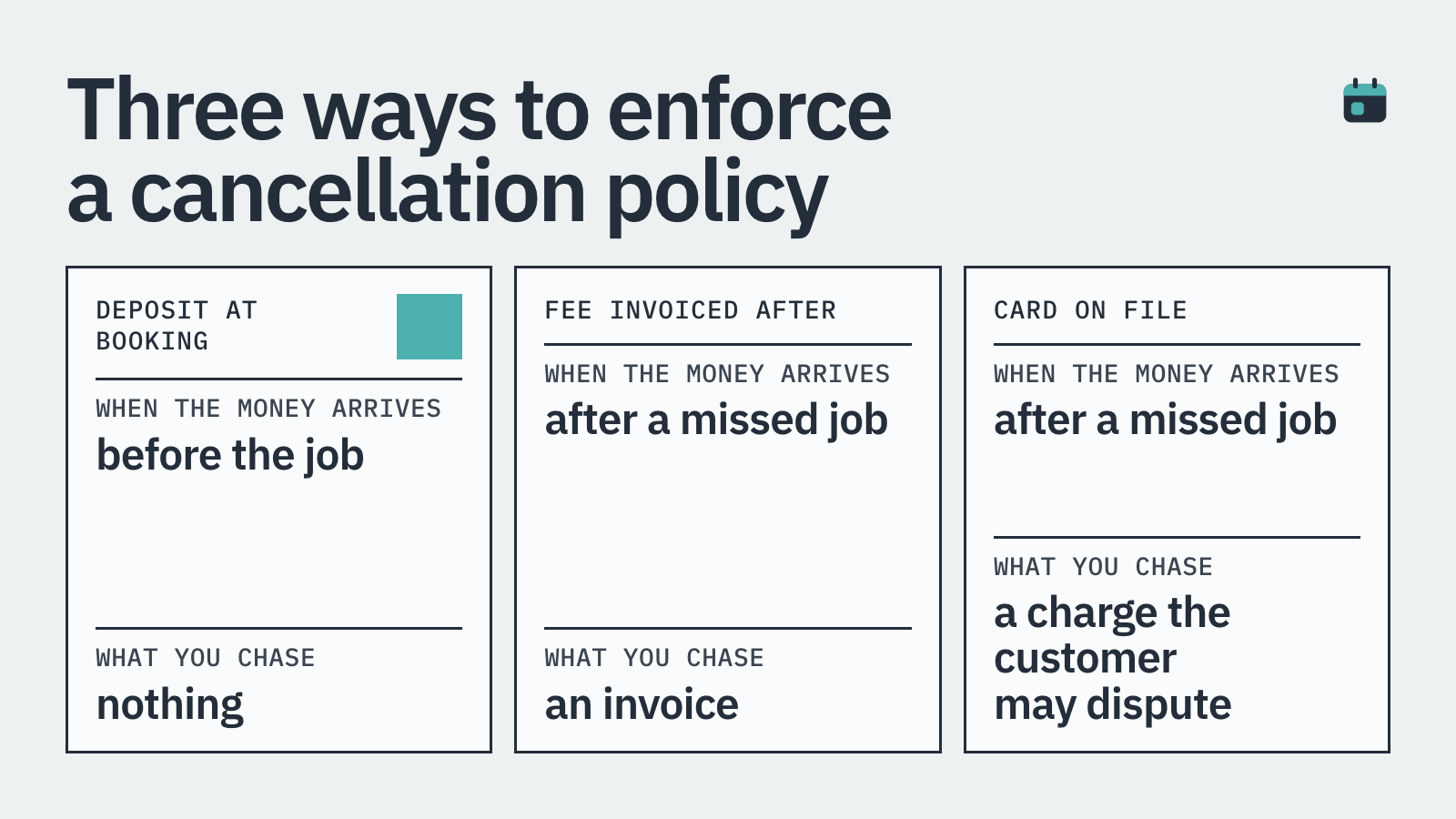
On timing: take the deposit at the point of booking, not the day before. Chasing a deposit after the fact is awkward and easy for the customer to avoid. If your booking system cannot take a deposit in the same flow as the booking, that is a gap worth fixing.
On refunds: set a clear cancellation window. 24 hours is standard for short appointments. 48 to 72 hours is more appropriate for longer or higher-value jobs. Be consistent. If you refund for someone who cancels at 23 hours because they have a nice excuse, your policy stops being a policy.
On no-shows: if a customer simply does not turn up, the deposit is yours. Make sure this is stated in your terms and that the customer agreed to those terms at the time of booking. A card-on-file setup also allows you to charge a no-show fee after the fact if you have the customer's prior consent.
Setting Up Deposit Collection in Your Booking System
This is where a lot of service businesses hit a wall. Tools like Calendly are great for scheduling meetings, but they were not built with deposit collection in mind. The same goes for Zoho Bookings, which can feel clunky to configure for payment-first service bookings. Acuity Scheduling has some payment features, but users often report that the deposit flow is not as intuitive as it should be for client-facing businesses.
Square Appointments and Housecall Pro are stronger on payments, but they come with wider feature sets and pricing that may not suit smaller or solo operators. They are solid tools, but worth evaluating based on your specific business size and workflow.
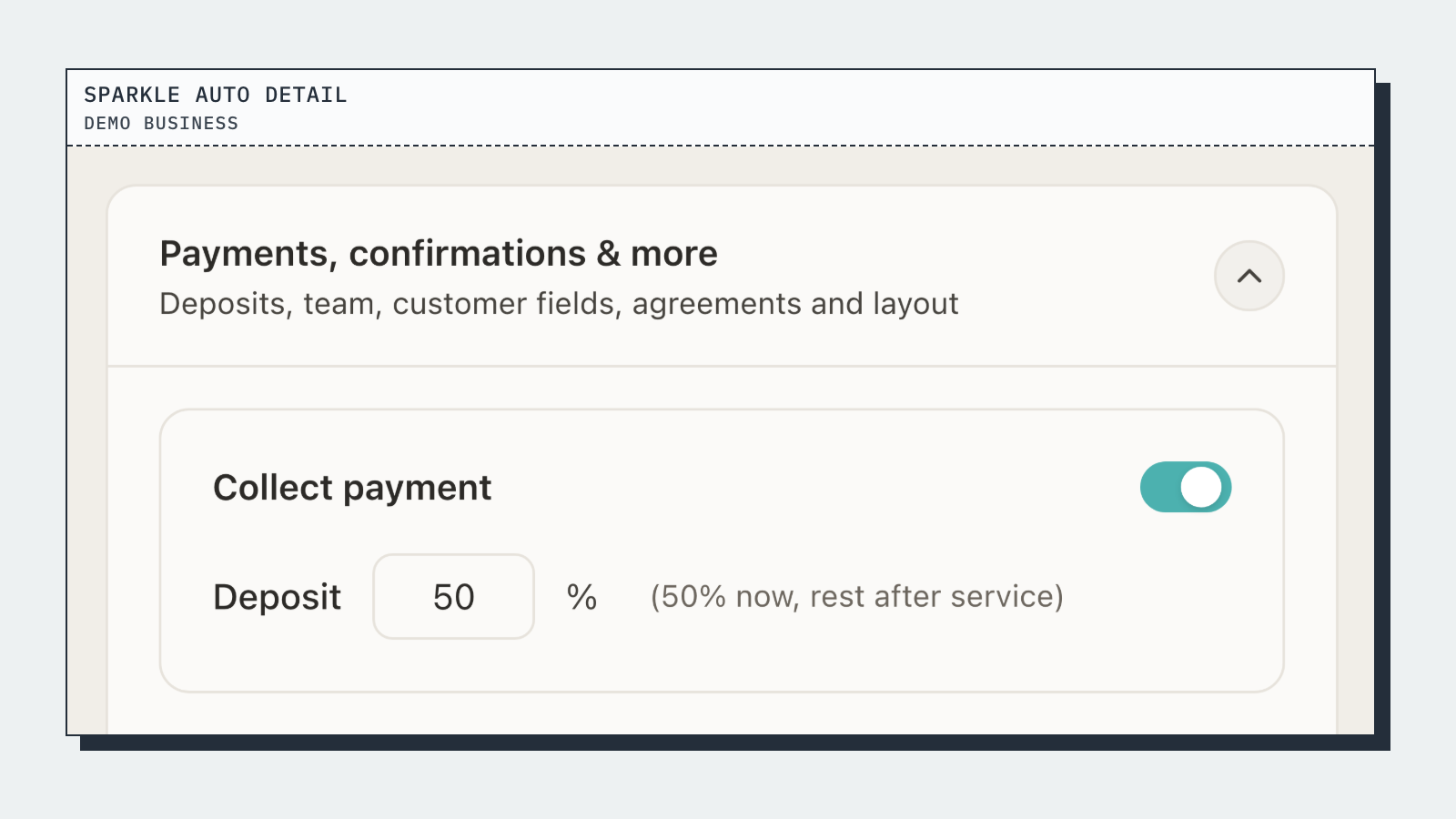
BookingMachine is built specifically for service businesses that need to collect a deposit as part of the booking itself. You embed it on your existing website, set a deposit amount or percentage per service, and the customer pays before their booking is confirmed. The deposit policy and cancellation terms are shown to the customer at checkout, and their card is held on file for any no-show charges. After the job is done, an automated review request goes out by text, complete with a link for the customer to leave a written review and upload photos or video. Everything is in one flow.
Calendly: great for meeting scheduling, limited deposit or payment support.
Acuity Scheduling: has payment features but not purpose-built for service-business deposits.
Square Appointments: solid for in-person businesses, broader feature set.
Housecall Pro: strong for trades and field service, more complex and priced accordingly.
BookingMachine: deposit collection, card-on-file, cancellation policy and automated review requests built into a single booking flow for service pros.
Communicating Your Policy to Existing Customers
If you are introducing a deposit policy for the first time with existing clients, a short heads-up goes a long way. You do not need to justify it at length. A brief message along the lines of: 'From [date], we will be taking a £25 deposit to secure appointments. This will be deducted from your total on the day. We appreciate your understanding.' That is enough.
Some long-standing clients may push back. Hold the line. Exceptions undermine the policy and signal that it is negotiable. If a client of three years genuinely cannot pay a £25 deposit, that tells you something useful about the relationship.
Display your policy on your booking page, in your confirmation emails, and as a note in any reminder messages. The more visible it is, the harder it is for a customer to claim they were not aware of it.
How it compares
| Feature | BookingMachine | Calendly | Acuity Scheduling | Square Appointments | Housecall Pro |
|---|---|---|---|---|---|
| Deposit collection at booking | Yes, built-in | No | Partial | Yes | Yes |
| Card-on-file for no-shows | Yes | No | No | Yes | Yes |
| Cancellation policy display at checkout | Yes | No | Limited | Yes | Yes |
| Automated review requests (text, image, video) | Yes | No | No | No | No |
| Embeds on your existing website | Yes | Yes | Yes | Limited | Limited |
| Built for service businesses (not just meetings) | Yes | No | Partial | Yes | Yes |
| Simple setup for solo and small teams | Yes | Yes | Yes | Yes | No |
How do you ask for a deposit from a customer without it being awkward?
The easiest way is to make it automatic. When your booking system requires a deposit before confirming the appointment, you never have to ask personally. The policy is just part of how bookings work with you. If you do need to communicate it directly, keep the language matter-of-fact: state the amount, confirm it comes off the total, and mention your cancellation window. No apology needed.
Is a booking fee the same as a deposit?
They work similarly but are not identical. A deposit is a partial payment credited toward the final bill. A booking fee is often a fixed, sometimes non-refundable charge to hold a slot. Both are legitimate. The important thing is that your terms are clear to the customer before they book.
What is the reason behind salons charging deposits?
Salon appointments, particularly for colour or treatments, are long and cannot easily be filled at short notice. A no-show or last-minute cancellation means the stylist sits idle for an hour or two with no income. The deposit compensates for that held time and filters out clients who are not genuinely committed to attending.
How much deposit should I charge?
A common range is 20% to 50% of the service value for most businesses. Salons often charge a flat £20 to £50 per booking. Trades typically ask for 25% to 30% of the job value. Freelancers frequently take 50% upfront. Pick an amount that covers your costs if the booking falls through, without being so high it puts customers off booking at all.
What happens if a customer refuses to pay a deposit?
That is useful information. A customer who will not commit £20 to secure a £150 appointment is a higher no-show risk than one who pays without hesitation. You can choose to accept bookings without deposits, but do so knowing the risk. Many service businesses find that clients who decline a deposit policy are the same ones who cancel last-minute.
Can I take a deposit on my existing website?
Yes, if your booking tool supports it and embeds on your site. BookingMachine, for example, embeds directly on your existing website and handles deposit collection, card-on-file storage and cancellation policy display all within the booking flow. You do not need a separate checkout or payment page.
Do I need to refund the deposit if a customer cancels in time?
That depends on your policy. If a customer cancels within your stated refund window (for example, 48 hours before the appointment), most businesses refund the deposit in full. If they cancel inside that window or do not show up, the deposit is typically kept. Whatever your terms are, make sure the customer agrees to them at the time of booking.
Start Taking Deposits With Every Booking
BookingMachine embeds on your website, collects deposits at the point of booking, holds cards on file for no-shows, and sends automated review requests after every job. No awkward conversations. No chasing payments. Just bookings that stick.